Industry challenge
Visual gaps between discrete warning lamps and complex machine boundaries
Application directory / Industrial safety
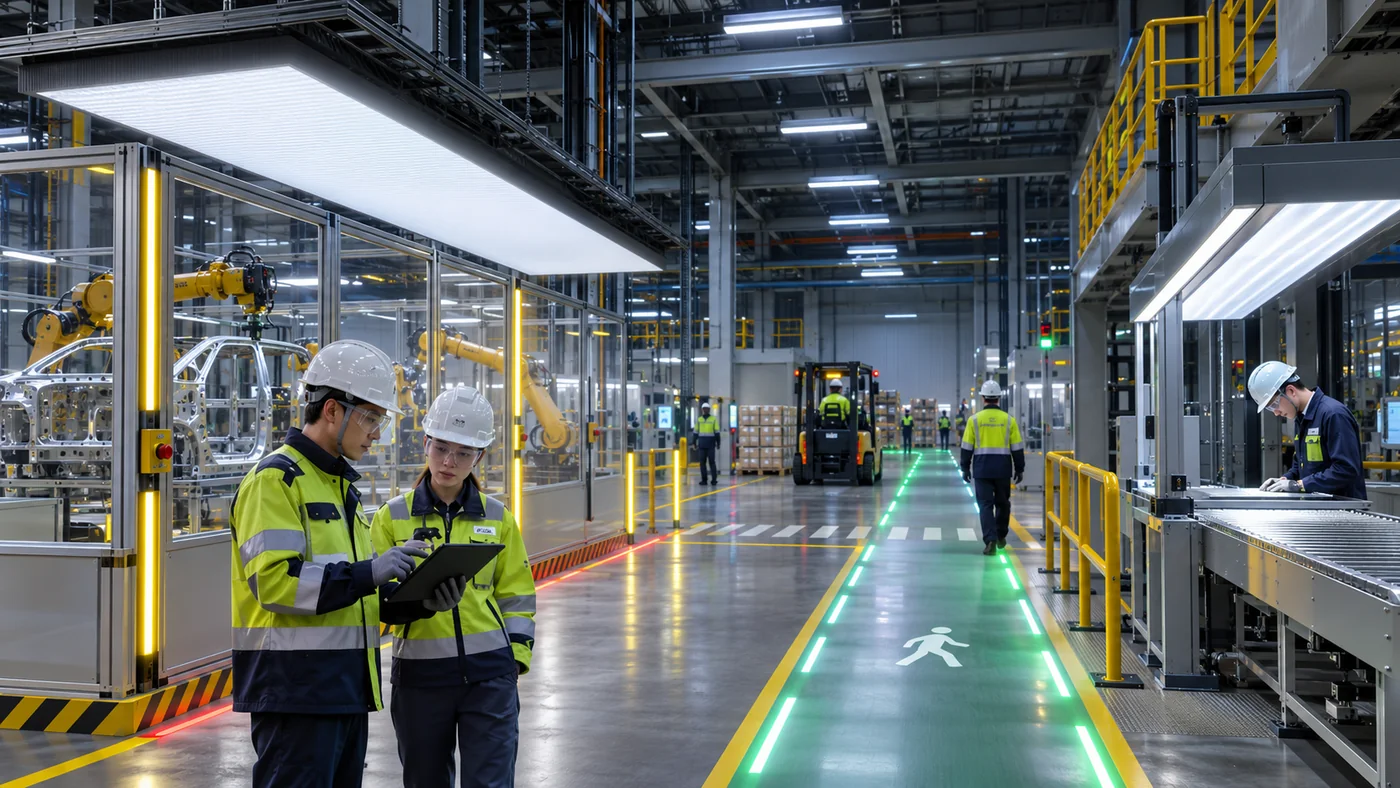
Visualize equipment state and hazard boundaries with continuous, color-coded light; remote engines allow separate service access.
Machine perimeter, access gates, safety guards and warning lanes linked to PLC/AIoT state.
Visibility, fail-safe behavior, abrasion and applicable EHS rules; supplementary indication, not a safety interlock.
Link visual guidance to fleet state and access zones without replacing machine safety systems.
Robot corridors, turning areas, pedestrian crossings and zone boundaries.
Engineering validation requirements: Fleet controller interface, visibility, fault response, abrasion and machinery safety review.
Continuous zone markings can support picking and movement information across large areas.
Picking zones, loading aisles, separation of pedestrian and equipment paths.
Engineering validation requirements: Abrasion, cleaning, visibility, workflow integration and site safety evaluation.
Integrate flexible light lines into moving textile or portable gear for supplementary identification.
Protective apparel, bags, straps and portable safety accessories.
Engineering validation requirements: Repeated bending, washing, skin contact, power safety and applicable PPE standards; no PPE certification claimed.
Separate LED heat generation from plant-proximate optical delivery; distribute photons through flat, curved and canopy-specific geometries.
Priority application for evaluationContinuous light on curved trim without placing LEDs along every luminous segment.
Visual gaps between discrete warning lamps and complex machine boundaries
Integrate continuous or segmented directional color-coded light with existing safety controls; keep the engine separate.
Pilot one guarded zone with a machinery OEM; verify visibility, ingress, failure modes and control interface. Not a substitute for mandated safety measures.
Application-specific performance, certification, rights and pricing require validation and written agreement.
Combined task illumination and machine-state indication is an established industrial product category.
WLS27 Pro / EZ-STATUS
Official product / technology sourceRoute continuous or segmented passive emitting fibers around machine outlines; design the local extraction sector toward operator sightlines. Connect RGBW or independently controlled engines to existing control interfaces.
Continuous visual boundaries, machine-state communication across complex geometry, flexible routing and accessible engine replacement. A distributed passive optical line can reduce the need for electrical components along its length.
Engineering evaluation metrics: Visibility, color contrast, response, failure modes, environmental rating and applicable safety qualification
Market benchmarks based on official sources reviewed 26 November 2026. Named organizations are independent examples, not OSL adopters or partners. Advantages are design opportunities, not guaranteed or measured improvements; product-specific validation and rights review are required. Concepts are not certified commercial products.
Engineering architecture comparison, ten market records, optical extraction animation and a tailored project brief.
Explore this industry in the innovation studio